Did you notice? Google just built something that looks remarkably like a CRM. They simply chose not to call it…
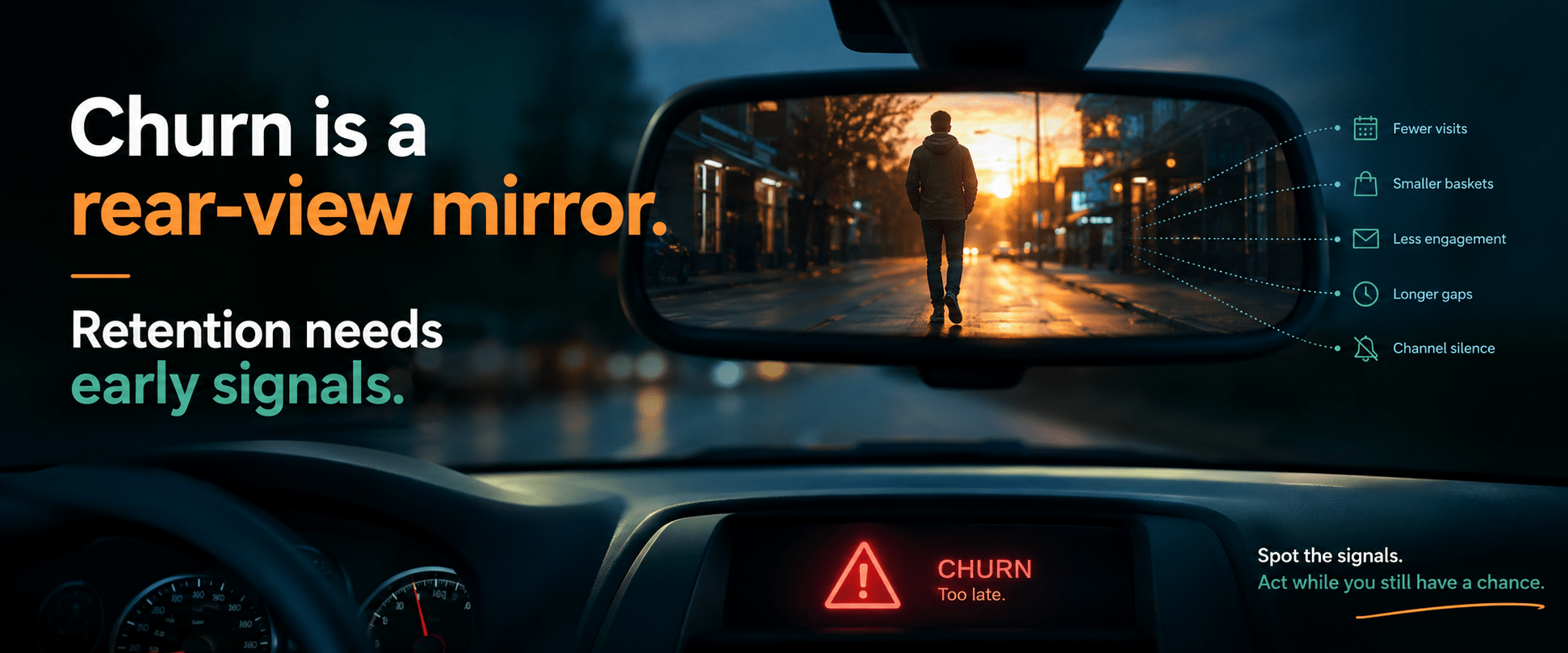
Churn is a rear-view mirror
By the time ‘churn’ shows up on your dashboard, your customer made their decision weeks ago.
This is the core problem with how many non‑subscription brands still measure retention. We stare at quarterly churn, repeat rate, or active customer counts and call that a retention view.
It is a rear‑view mirror.
If you work in retail, hospitality, FMCG, you do not need better churn reports. You need better signals.
Here is a simple way I tend to frame it in conversations with teams:
1. Define your ‘silent churn’ window
Instead of asking “who churned last quarter?”, ask “when would we start to worry about this customer?”.
For a coffee chain, like Cafe Bica, that might be:
- Regulars: visit at least 1x per week. At risk after 14 days of no visit.
- Occasionals: 1x per month. At risk after 45 days of no visit.
For a fashion retailer, it is for example:
- High frequency: 4+ orders per year. At risk after 120 days.
- Low frequency: 1–3 orders per year. At risk after 240 days.
You now have a silent churn window, by segment.
2. List observable early signals
Within that window, what changes first when a customer drifts away?
Typical patterns I keep seeing:
– Shrinking basket size over 3–4 purchases
– Longer time between visits or orders
– Shift to discount‑only purchases or redemptions
– Engagement drop‑off: no opens, no clicks, no app sessions
– Channel silence: they stop reacting on the channel that used to work
Keep it practical. Start with 5–7 signals, not 50.
3. Turn 2–3 signals into always‑on triggers;
Discuss with us if they are not default triggers; we can customize them for you. There’s a good reason to do so. Pick the ones you can measure reliably and wire them into simple rules with us.
Example from hospitality:
– Rule 1: Weekly guest, no visit for 10 days + last 2 checks were discount‑driven → invite to a non‑discount perk (early access, table preference) instead of more coupons.
– Rule 2: Regular room guest, stay gap 20 percent longer than usual + app inactivity → light reminder with a useful reason to return, not a blanket promotion.
The point is not the ‘1’ perfect action. The point is that the system responds while you still have a chance, instead of a big ‘save’ campaign after the quarter is over.
4. Retrain the system continuously
We’ll do that with you. Whatever you put live will be wrong in some way in the first version.
Review, per trigger:
– Did it actually pull visit frequency back into the healthy range?
– For whom did it work, for whom did it not?
– Which signals turned out to be noisy and can be dropped?
Then adjust the windows, tighten the rules, and keep going. The best setups I see treat retention as a living set of signals and responses, not a static metric pack.
Talk to us about this.
Related VEMT Resources